How to Feed 200 Guests on a Budget (Philippines)
By WedPlanner Team
Feeding 200 guests doesn’t have to wreck your wedding budget. This guide breaks down 2026 cost-per-head realities for Filipino wedding catering, compares buffet vs plated pricing, and shows how to negotiate with caterers.
How to Feed 200 Guests Without Going Broke: Filipino Wedding Catering on a Budget (wedding budget Philippines)
Quick Answer: If you’re planning a wedding budget Philippines catering plan for 200 guests, focus on cost-per-head math, menu engineering, and service style (buffet vs plated). Expect most “all-in” catering packages to land roughly in the mid-hundreds to low-thousands of pesos per person—then control lechon, desserts, and bar spending.
Introduction
Filipino weddings are known for abundance—good food, full plates, and a party that keeps going. But when you start budgeting for 200 guests, catering can become the fastest way to exceed your wedding budget Philippines target.
In 2026, costs feel higher, but you still have levers: how caterers price labor and service, whether you choose buffet or plated, how you order lechon (whole vs by the kilo), what dessert buffet looks like, and whether you set up a no-host bar so alcohol doesn’t quietly explode your costs.
This post is practical by design: you’ll get sample numbers (in PHP), a negotiation script, and a budget framework you can reuse with caterers until the proposal fits.
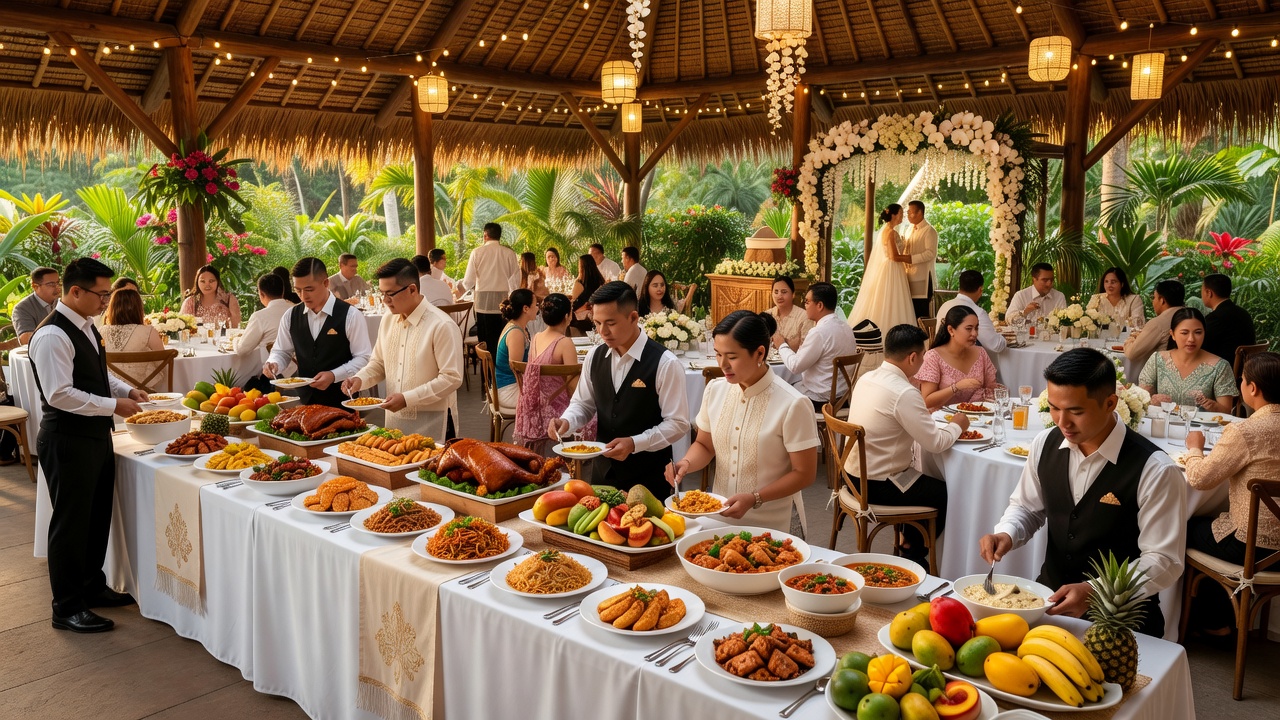
What Is “Cost-per-Head” and Why It Decides Your Catering Budget?
Short answer: Cost-per-head is the total catering-related spend divided by the number of guests. For weddings, it must include not just food, but also service and common extras (ice, staff, disposables, delivery, and sometimes venue-related fees).
When people say “we’ll just get a cheaper package,” they often compare only one line item—like “food per person.” The trick is to compare the same package boundaries across proposals.
A budgeting checklist you can copy
- Food: viands, rice, sides, soup (if included), lechon, bread/rolls
- Service: waiters, platters, buffet attendants, cleanup crew
- Serving ware: disposable vs reusable, plates, cups, utensils
- Logistics: delivery fee, setup fee, transport of lechon/food
- Ice + water: drinks service often “forgets” these costs
- Sweet ending: dessert buffet items + staffing
- Bar strategy: open bar vs no-host bar (huge swing)
Featured snippet tip: If you need to explain this to your partner or families: “Our catering cost isn’t just the viands per head—it’s food + service + serving setup, divided by 200.”
2026 Cost-Per-Head Realities: What Should You Expect for 200 Guests?
Because venue, city, and guest mix vary, no single number will perfectly match your wedding. But you can still plan with realistic ranges.
Rule of thumb for wedding planners: Build two scenarios: a buffered budget (includes likely add-ons) and a target budget (lean but workable).
Sample catering cost ranges (PHP) you can use to model proposals
Below is a planning range for 200 guests. Treat it as a negotiation anchor—not a promise.
- Buffet-style catering: ~₱600–₱1,200 per person for food + core service (varies by menu complexity and lechon inclusion)
- Plated service: ~₱900–₱1,800 per person because service labor and staging are more expensive
- Lechon as a centerpiece: can be ₱25,000–₱120,000+ depending on size, supplier, and how many servings you need
- Dessert buffet add-on: ~₱150–₱450 per person depending on what’s offered (and whether it replaces another dessert)
- No-host bar: shifts cost from your budget to your guests (you still may pay for basics like ice/water)
If you tell caterers “Our wedding budget Philippines target is ₱X per head all-in,” you’ll get better, more comparable bids than “We want it cheaper.”
Buffet vs Plated Service Pricing: What’s the Real Difference?
Short answer (40–60 words): Buffets typically cost less because food is staged and guests serve themselves, reducing waiter time and per-table plating labor. Plated service costs more because it requires additional staff, consistent portioning, and a tighter kitchen-to-dining workflow—especially for 200 guests.
How caterers usually price each option
Buffet pricing tends to include
- Food in chafers/steam trays
- Buffet attendant(s) for refills
- More flexible pacing (especially for large weddings)
Plated pricing tends to include
- Portion control per plate
- More waitstaff per table and more staging
- Extra time buffers (risk management)
Budget-friendly strategy: Choose buffet for “main volume” and consider plated only for a premium moment (e.g., one specialty dessert or a welcome drink). This keeps costs under control without looking “budget.”
How to Negotiate With Caterers (Without Starting a Fight)
Negotiation works best when you treat it like a cost audit. You’re not asking for a discount—you’re asking for value alignment inside your wedding budget Philippines.
Ask for a line-item proposal (this is non-negotiable)
- Food per person
- Service staff count and what their role covers
- Lechon inclusions (size, servings estimate, sauce, server setup)
- Delivery/setup fees
- Replacement policy if items run out (and what happens)
Use the “menu engineering” negotiation script
You can say:
- “We’re targeting ₱___ per head all-in.”
- “Can we keep the vibe but swap items to reduce cost?” (e.g., fewer expensive garnishes, adjust seafood portions)
- “Can we keep two meat viands and reduce one premium component?”
- “Can you quote buffet only—then tell us the price difference if we go plated?”
Negotiate risk, not quality
Instead of “Please make it cheaper,” negotiate things like:
- Packaging: choose disposable if your venue allows (or include only the items you need)
- Refill plan: agree on a refill schedule to prevent late-night shortages
- Timing: set a realistic serving window (prevents extra labor charges)
- Staff: ask how many servers for 200 and what the coverage is
Watch out for hidden cost traps
- “Food included” but service not included
- Lechon priced without setup/serving tools
- Dessert buffet that’s really “pre-packed cups” (fine, but price it accordingly)
- Open-bar assumptions (even 1–2 free drink options can add up)
Professional tip: If a caterer refuses line-item clarity, that’s a red flag for budget control.
The Lechon Question: Whole Lechon vs By the Kilo
Lechon is the heart of many Filipino weddings—also one of the easiest budget blow-ups. The best choice depends on servings needed, your timeline, and how the caterer stages it.
Short answer (40–60 words): Whole lechon is convenient for a “centerpiece” moment and often includes smoother sourcing and staging, but it can become pricey if you overbuy weight. Buying by the kilo can be cheaper and more precise—if the supplier clearly estimates servings and you plan portions tightly.
Whole lechon: when it makes sense
- You want a dramatic, traditional centerpiece
- Your venue has the space and setup support
- The caterer can slice efficiently and keep the lechon presentable
By the kilo: when it makes sense
- You want tighter control on cost-per-head
- You’re okay with a slightly less “full roast presentation” vibe
- You trust the supplier’s serving estimate (ask for it in writing)
A practical servings method (use this to negotiate)
Instead of arguing about “price per kilo,” ask: “How many guests does your lechon weight serve, and what slice thickness?” Then ensure you budget for the wedding reality that not everyone eats the same amount of lechon.
Negotiation idea: Request an “intake” buffer like this: you want enough lechon for ~70–85% of guests to take a full portion, while the remaining guests get lighter servings supported by rice, other viands, and sides.
Budget-friendly lechon plan for 200 guests (example framework)
- Lean approach: 1 lechon centerpiece with sufficient lechon servings for the majority + extra chicken/pork viand sides
- Balanced approach: lechon sized for “guests who take lechon first,” plus cheaper viand redundancy (so you don’t run out)
Ask caterers to show their math—if they can’t estimate servings clearly, you’re likely to pay for wasted weight.
Dessert Buffet Alternatives That Still Feel “Wedding”
At Filipino weddings, dessert isn’t just “after.” It’s part of the celebration flow, especially with a dessert buffet.
Key idea: Don’t build a dessert buffet that’s too wide. Build a dessert buffet with high impact and controlled portions.
Budget-friendly dessert buffet options
- Halo-halo station (portion controlled): Add-ons like nata de coco + sago + leche + shaved ice can be staged to prevent overserving
- Fruit + pudding combo: Mix seasonal fruit cups with gelatin/pudding shooters
- Leche flan “shooters”: Looks upscale in small cups and reduces waste
- Mini cakes or bar desserts: Brownies + bar cakes portion well
- Ube-themed dessert: Ube pudding or ube macapuno cups can deliver a Filipino “signature” without premium complexity
Better than “too many desserts”
Instead of 6 dessert items, aim for 3–4 strong choices. A well-curated dessert buffet looks fuller because each station is stocked and staffed.
How to negotiate desserts
- Ask for dessert portion size per guest (or per serving ladle/cup)
- Request a “minimum guaranteed stock” plan
- Replace expensive garnishes with budget-friendly equivalents (ex: less edible gold/limited nuts unless truly premium)
No-Host Bar Strategy: Keep the Party Without Paying for Every Drink
Alcohol costs can quietly inflate a catering budget—especially if “open bar” turns into “unlimited refills for everyone.” A no-host bar is a budget-friendly strategy that shifts drink spending to guests while keeping the wedding lively.
Short answer (40–60 words):: A no-host bar lets guests pay for drinks directly, so your wedding budget Philippines stays predictable. Your job is to set clear pricing tiers, offer a limited menu, and plan basics like ice and water so the bar feels complete without becoming an open-ended cost.
How to structure a no-host bar for 200 guests
- Choose a tight menu: beer, wine (optional), signature mocktail, and a “classic cocktail” only if you can control portions.
- Create price tiers: keep it simple—one price for beer bottles, another for cocktails, another for mocktails.
- Decide who pays for bar essentials: often you cover ice and water; guests cover drinks.
- Plan for payment clarity: cash + QR/cashless if your venue supports it.
- Assign bar staffing: request an explicit bar team count and whether they’re separate from catering staff.
What guests need to feel it’s fair
- A clear drink menu with prices
- A visible bar signage system
- Alternatives (mocktails + soft drinks) so non-drinkers feel included
Important: If you worry about pressure, you can blend strategies: no-host bar for alcohol, plus a small all-guest non-alcohol welcome drink (like juice or a signature mocktail) included in your catering package.
Sample Budget Breakdown (PHP) for 200 Guests (Two Scenarios)
Use the table below as a negotiation starting point. Adjust the ranges based on your venue city, season, and how much of the lechon/desserts are included in the catering package.
Assumptions for this example: 200 guests, Filipino reception, buffet-style main meal, dessert buffet included as add-on, and no-host bar for alcohol. Service covers food staging and cleanup basics.
Budget scenario A: Lean-but-credible buffet
| Line item | What it covers | Estimated cost (PHP) | Cost-per-head impact |
|---|---|---|---|
| Buffet catering package | Viands, rice, sides, soup (if included), basic service | ₱120,000–₱200,000 | ₱600–₱1,000 |
| Lechon (whole or by kilo) | Centerpiece + slicing service estimate | ₱45,000–₱80,000 | ₱225–₱400 |
| Dessert buffet add-on | 3–4 dessert options, portion-controlled serving | ₱30,000–₱65,000 | ₱150–₱325 |
| Drinks support (non-alcohol basics) | Ice, water, soft drinks (if included) | ₱10,000–₱25,000 | ₱50–₱125 |
| Serving ware & disposables | Plates/cups/utensils depending on package | ₱8,000–₱20,000 | ₱40–₱100 |
| Service labor buffer | Extra attendants/refills contingency | ₱12,000–₱25,000 | ₱60–₱125 |
| Total estimate (Scenario A) | ₱225,000–₱415,000 | ₱1,125–₱2,075 per head |
Budget scenario B: Upgrade vibe without going broke
This scenario adds stronger dessert “wow factor” and possibly a more premium lechon presentation, while keeping the no-host bar strategy.
| Line item | What it covers | Estimated cost (PHP) | Cost-per-head impact |
|---|---|---|---|
| Buffet catering package | More variety + upgraded sides | ₱170,000–₱260,000 | ₱850–₱1,300 |
| Lechon (bigger centerpiece or optimized weight) | More servings buffer + better staging | ₱65,000–₱105,000 | ₱325–₱525 |
| Dessert buffet upgrade | Halo-halo station or premium dessert shooters | ₱45,000–₱95,000 | ₱225–₱475 |
| Welcome drinks / non-alcohol set | Mocktail/juice inclusion for all guests | ₱15,000–₱35,000 | ₱75–₱175 |
| Serving ware & disposables | Better presentation/quantity controls | ₱12,000–₱30,000 | ₱60–₱150 |
| Service labor buffer | Extra refills + cleanup | ₱18,000–₱35,000 | ₱90–₱175 |
| Total estimate (Scenario B) | ₱325,000–₱560,000 | ₱1,625–₱2,800 per head |
Budget reality note: If your venue requires separate corkage, permits, or extra staffing, add those before comparing packages. Otherwise, you’ll think you “found a cheap caterer” only to pay later.
7 Budget Mistakes Filipino Couples Make With Catering (and How to Fix Them)
If you want to avoid going broke, learn from the common traps. Here’s what usually happens—and what to do instead.
- Comparing proposals without normalizing what’s included
Fix: Ask for line-item clarity (food, service, lechon inclusions, dessert, logistics). - Overbuying lechon weight “just in case”
Fix: Negotiate servings math and slice thickness; ensure redundancy with other viands. - Choosing plated service for the whole reception
Fix: Keep buffet for 200; consider plated only for one premium moment. - Adding too many dessert items
Fix: Use 3–4 strong desserts with portion control and steady refills. - Forgetting service coverage details
Fix: Ask staff count and what they do (refills, cleanup, buffet monitoring). - Accepting “open bar” quietly
Fix: Switch to no-host bar and define what you cover (ice/water vs alcohol). - Not budgeting for extras
Fix: Add contingency (5–10% in many real wedding budgets) for price adjustments and shortfalls.
Best Practices for Filipino Wedding Catering on a Tight Wedding Budget Philippines
Build your menu around “fullness,” not only “expensiveness”
Guest satisfaction usually comes from variety, timing, and perceived abundance. You can create that with:
- Two meat viands + one “comfort” side
- Rice + a starch alternative (depends on your audience)
- One soup option that feels fresh and warm
- Controlled lechon servings supported by other dishes
Create a serving flow that prevents “late emptiness”
For 200 guests, refills matter. Ask caterers to propose a refill plan and staff roles so buffet stations stay looking full.
Keep communications in writing
Before payment, confirm:
- Exact items included
- Lechon weight/serving estimate
- Dessert items + portion style
- No-host bar menu and pricing responsibility
Key Takeaways
- Start with cost-per-head that includes food, service, serving ware, logistics, dessert, and drink strategy—not just viands.
- Buffet usually costs less for 200 guests; plated service increases labor and staging complexity.
- Negotiate using line-item proposals and menu engineering (swap ingredients, control portion sizes, clarify staff coverage).
- Lechon budgeting is a math problem: ask for servings estimates and negotiate weight based on realistic guest intake.
- Dessert buffet alternatives like halo-halo stations, leche flan shooters, and fruit+pudding combos can feel premium while staying within wedding budget Philippines targets.
- No-host bar keeps costs predictable while maintaining a lively reception vibe.
Frequently Asked Questions
How much should we budget per head for a wedding budget Philippines with 200 guests in 2026?
Most couples plan around a buffet cost range plus add-ons like lechon and desserts. As a planning baseline, you can model roughly ₱600–₱1,200 per person for core buffet catering, then add lechon, dessert buffet, serving ware, and non-alcohol basics. No-host bar helps keep the total predictable.
Is it cheaper to do buffet or plated service for 200 guests?
Buffet is usually cheaper because food is staged and guests serve themselves, reducing waitstaff time and portioning labor. Plated service can look elegant, but for 200 guests the service workflow costs more. A middle ground is buffet for the main meal and a premium plated moment.
Whole lechon or lechon by the kilo—what’s better for staying on budget?
Whole lechon can be worth it if you want a centerpiece effect and the supplier can slice and stage efficiently without wasting weight. By the kilo can be better for tight budgets if the supplier clearly provides servings math. Either way, confirm estimated servings in writing.
What dessert buffet alternatives work if our budget is limited?
Choose fewer but stronger dessert stations: halo-halo with portion control, leche flan shooters, fruit cups paired with pudding/jelly, or bar desserts like brownies. You’ll get better “wedding feel” because your stations stay full instead of stretching your dessert budget across too many items.
Should we include an open bar in the catering package?
Open bar is where wedding budgets often slip. A no-host bar strategy shifts drink spending to guests while keeping the party lively. You can still include non-alcohol basics or a small welcome drink to ensure everyone feels included, especially non-drinkers.
How do we negotiate with caterers if both families have strong opinions?
Bring your wedding budget Philippines target and ask for line-item proposals. Use menu engineering: keep the signature elements families want (like lechon and a dessert station) but swap secondary items, tighten portion sizes, and clarify service coverage. Negotiation works better when it’s framed as value control, not “please cut everything.”
What’s the biggest hidden cost in Filipino wedding catering for 200 guests?
It’s often service coverage and logistics: delivery/setup fees, serving ware, extra attendants for refills, and cleanup. Another frequent hidden cost is alcohol when open bar becomes “everyone gets free refills.” Ask for explicit inclusions and confirm responsibilities for bar setup and ice.
What should we ask caterers to put in the contract?
Include: exact menu items, lechon size or kilo and servings estimate, number of staff and their roles, dessert list and portion style, serving ware notes, delivery/setup schedule, and refund/replacement terms if quantities run short. For no-host bar, confirm who provides ice/water and who manages pricing and staffing.
Conclusion
Feeding 200 guests on a budget is absolutely doable in a Filipino wedding—if you plan like an accountant and negotiate like a project manager. Start from cost-per-head, choose buffet strategically, treat lechon and desserts as controlled centerpiece items, and use the no-host bar strategy to protect your wedding budget Philippines.
Next step: Share your guest list (200), target per-head number (your ceiling), and whether you want buffet or plated. Then request line-item bids from 2–3 caterers and compare them apples-to-apples. If you want, I can help you turn your target into a negotiation checklist.