How to Write Your Own Filipino Wedding Vows
By WedPlanner Team
This guide helps Filipino couples write personal wedding vows with heartfelt promises, naturally blended English and Tagalog, a comfortable vow length, and practical ways to feel confident while speaking.
How to Write Your Own Wedding Vows: Filipino Wedding Planning Guide
Quick Answer: Start with your relationship story, then turn it into 3–5 specific promises you can live out. Blend English and Tagalog by keeping one language for the “setup” and using Tagalog for emotional lines. Aim for ~80–150 words (about 45–75 seconds) per person, and rehearse with cues to ease nerves.
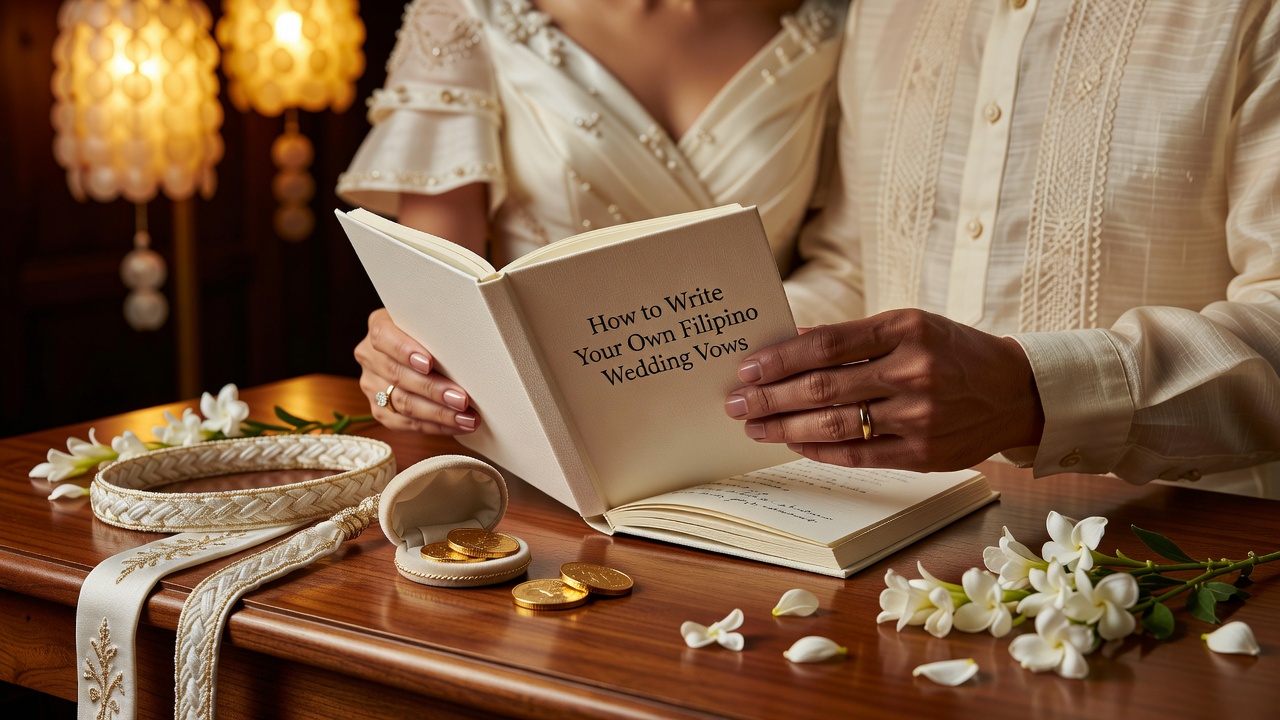
Introduction
Writing your own wedding vows feels beautiful—and intimidating. If you’re planning a Filipino ceremony, you may also want your vows to sound like you: sincere, respectful, and connected to family values. Whether you’re having a civil or church wedding, you can craft promises that feel personal without losing clarity or rhythm.
In this step-by-step Filipino wedding vows guide, you’ll learn how to structure your vows, blend English and Tagalog naturally, choose a comfortable length, and practice when public speaking makes you nervous.
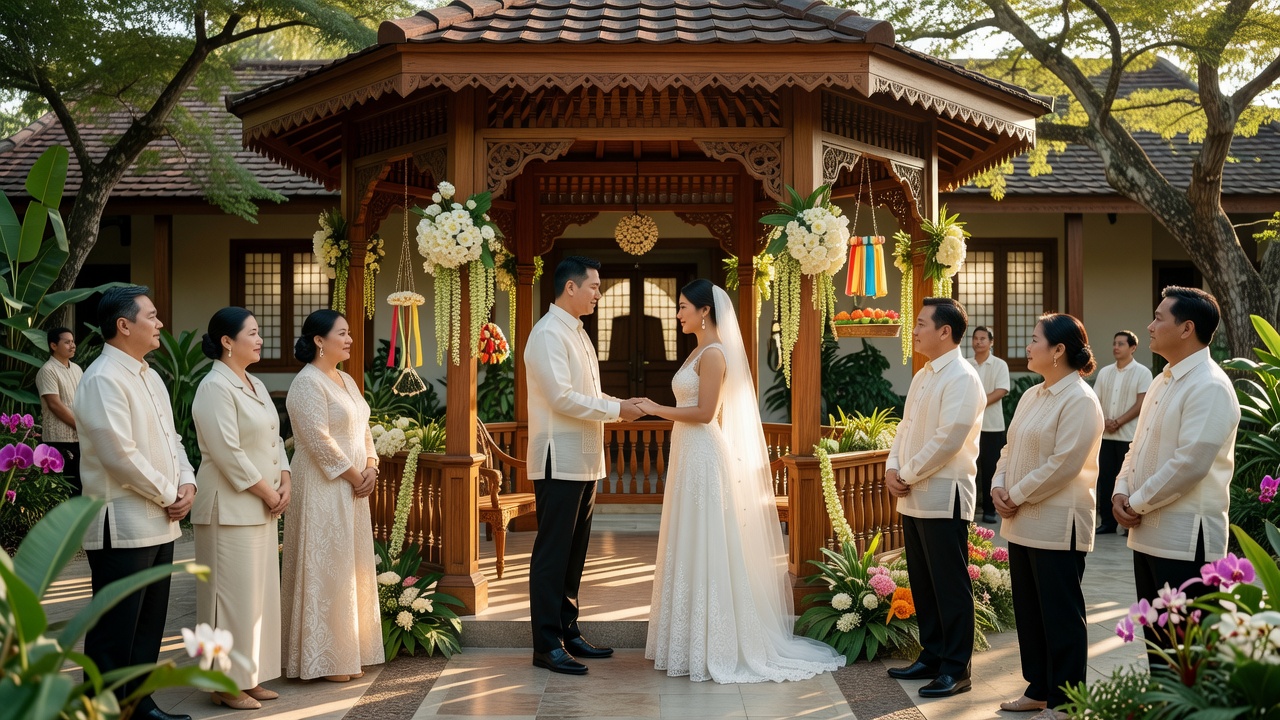
What makes wedding vows feel truly “Filipino”?
Vows aren’t just words. In Filipino weddings, they often carry a sense of commitment that’s deeply relational—honoring love, but also acknowledging community, respect, and shared responsibility.
Think of “Filipino-coded” vow elements as:
- Paggalang (respect): Your tone and language show honor toward your partner and, if relevant, your families.
- Pangako (promises): Clear commitments like “I will be faithful,” “I will support you,” “I will choose us,” expressed in a way that feels grounded.
- Family and bayanihan (togetherness): Promises that include teamwork—especially during stressful seasons.
- Faith and gratitude (if your ceremony includes it): A line that acknowledges God, gratitude, or guidance—without making it feel like a script.
- Warm emotional language: Tagalog phrases can carry tenderness quickly—use them where your heart wants to speak.
Featured snippet tip: If you’re unsure where to start, write your vows in three parts: Story (one sentence), Promises (3–5 lines), and Closing (one line that sounds like a decision).
How Filipino wedding planning can shape vows that sound like you
If you’re doing Filipino wedding planning—especially for family-centered ceremonies—you’ll notice that your vows are usually expected to be clear, respectful, and heartfelt. That means your vows should be easy for guests to follow, not overly long or abstract.
Here’s how to translate Filipino wedding planning values into your writing:
- Keep promises specific. Instead of “I will always love you,” try “I will listen when you’re overwhelmed and remind you you’re not alone.”
- Use “respect language” naturally. Even in English, you can sound respectful—Tagalog helps, especially when you want warmth.
- Balance emotion with structure. A short, clear structure helps you sound confident and keeps the tone appropriate for formal ceremonies.
- Practice pacing like a Filipino host. Slow down for key lines and pause after promises. Pauses make your vows land.
- Include one line that includes “tayo/us.” Filipino weddings often feel communal—let your vows show teamwork.
Best vow length for a wedding ceremony (so you don’t run out of time)
For most ceremonies, a strong goal is ~45–75 seconds per person, which is about 80–150 words. This length works because it’s long enough to be personal, but short enough for guests to stay engaged and for you to speak confidently.
| Vow goal | Approx. words | Approx. time | Best for |
|---|---|---|---|
| Short | 60–90 | 30–45 sec | Quick civil ceremonies, nervous speakers |
| Ideal | 90–150 | 45–75 sec | Most church and reception timelines |
| Long | 150–220 | 75–110 sec | If your emcee confirms you have extra time |
Pro tip: If your ceremony script is tight, write a “core vow” first (90–120 words), then add one extra line of Tagalog for emotion.
Step-by-step: write your own vows (English + Tagalog)
Use this process like a workshop. You’ll end up with vows that are personal, speakable, and culturally grounded.
Step 1: Write your “relationship story” in 1–2 sentences
Choose a memory that shows love and growth. In Filipino context, moments like family hospitality, shared resilience, community gatherings, or “we got through it together” are especially meaningful.
Example (bilingual-ready):
“I met you at a time when I didn’t know what I was building. When we chose each other, everything felt possible—kasama ang mga pagsubok.”
Step 2: Turn feelings into 3–5 concrete promises
Promises should be behavioral—what you will do (not just what you feel).
Promise categories that work well:
- Emotional support: “I will listen,” “I will choose kindness.”
- Faithfulness & integrity: “I will stay true,” “I will protect our trust.”
- Teamwork: “We will face challenges together,” “I will help carry the load.”
- Family respect: “I will speak with respect,” “I will be patient as we build our family.”
- Future hope: “I will grow with you,” “I will keep learning how to love you.”
Example promise:
“I will be your safe place—when life is loud, I will be gentle, patient, and present.”
Step 3: Choose where to blend English and Tagalog (naturally)
Code-switching works best when it follows a pattern that feels intentional—not random.
Three easy blending methods:
- English setup, Tagalog emotion: Write most of the vow in English, then insert Tagalog for the most heartfelt lines.
- Tagalog promise phrases, English explanations: Start a line with Tagalog (“Pangako ko…”) and finish the sentence in English.
- Repeat a signature Tagalog phrase: Example: “habang-buhay” or “kasama mo” as a refrain at the beginning or ending.
Example structure using both languages:
“I promise to choose you every day—habang-buhay. I will keep our home filled with respect, laughter, and effort.”
Step 4: End with a “decision” line
Your closing should sound like commitment. In Filipino ceremonies, a closing often feels powerful when it includes gratitude or a promise of perseverance.
Closing options:
- “I choose you—today and in every season after.”
- “I will love you with my actions, my patience, and my faith.”
- “Mula ngayon, tayo—at gagawin ko ang lahat para magtagumpay tayo.”
Step 5: Edit for speakability (the “read it out loud” rule)
Once you draft, do three passes:
- Clarity pass: Remove any line that’s hard to pronounce or might confuse guests.
- Rhythm pass: Keep sentences short. Add pauses after promises.
- Heart pass: Keep at least 1–2 lines that feel like you’d say them to your partner in private.
Goal: When you read it aloud, it should sound like conversation—not like a speech you memorized word-for-word.
Sample vow structures and templates (copy, personalize, speak confidently)
Below are ready-to-use frameworks Filipino couples can personalize. Choose one that matches your style—short and sweet, balanced, or poetic.
Template A: The “Story + 3 Promises + Closing” vow (beginner-friendly)
Vow outline:
- Story: 1 sentence
- Promises: 3 lines
- Closing: 1 sentence
Fill-in template (bilingual):
“Before today, I didn’t realize how much I needed you. When we met, I felt [brief moment].
I promise to [Promise #1—behavior], especially when [stress].
I promise to [Promise #2—behavior], with patience at all times.
I promise to [Promise #3—behavior]—habang-buhay, kasama ang lahat ng pagsubok.
I choose you, and I will keep choosing you in every season ahead.”
Template B: The “Paggalang + Teamwork” vow (Filipino cultural emphasis)
Best for couples who want respect + family values to show clearly.
Fill-in template:
“Today, I stand with gratitude—not only for you, but for the love that raised us and shaped us. I admire the way you [specific trait].
My promise is simple: I will love you with respect—paggalang—and I will speak with kindness even when we disagree.
I will be your teammate in decision-making, our ‘bayanihan’ in hard seasons, and your partner in joy.
Kapag pagod na tayo, maghahanap ako ng paraan para maging calm, para maging strong, at para manatiling totoo tayo sa isa’t isa.
I commit to us—today and all our tomorrows.”
Template C: The “Poetic but still clear” vow (for expressive speakers)
Structure:
- One poetic line (short)
- 2 practical promises
- 1 Tagalog emotional line
- One faith/gratitude or decision line
Example template:
“In your arms, I found a home I didn’t know how to name.
I promise to [Promise #1—practical], and to [Promise #2—practical].
At pag dumating ang hirap, pipiliin kong maging buo—kasama mo.
Salamat sa pagdating mo sa buhay ko. I vow to love you faithfully, with courage and patience.”
What about religious vows?
If your ceremony includes faith language (common in many Filipino weddings), you can include it without sounding generic.
Rule of thumb: Personalize faith lines using your own meaning.
Example options (adapt as needed):
- “I trust that God will guide us, and I will do my part to show love through my choices.”
- “Sa harap ng Diyos, I commit to be steadfast, honest, and kind—especially when it’s hard.”
When unsure: Keep religious sentences shorter and confirm with your officiant if needed.
How to deliver your vows if you’re nervous about public speaking
Most couples feel nervous. Nervousness usually means you care. Your job isn’t to “perform perfectly”—it’s to communicate honestly.
Step-by-step delivery plan (simple and effective)
- Practice in 3 speeds: (a) fast, (b) normal, (c) slow. Then use the slow version for your real vows when emotions rise.
- Mark your pauses with a slash (/) in your notes (or on a card). Pauses make you sound confident.
- Use a “cue” system, not word-perfect memorization: Memorize your outline (Story → Promises → Closing), not every word.
- Write one “anchor line” you can always say if you blank (often your Tagalog signature line).
- Do a mic check. If you can, rehearse one line near the microphone so volume matches your voice.
- Before you speak: inhale for 3–4 seconds, exhale for 4–5 seconds, then begin gently.
Keep your nervous energy helpful
Nervousness often makes people speak too fast. Correct that by:
- reading slightly slower than feels natural,
- lowering your voice at the start of each promise,
- smiling softly (it steadies breath), and
- looking at your partner first for the opening sentence.
Practical formats that reduce stress
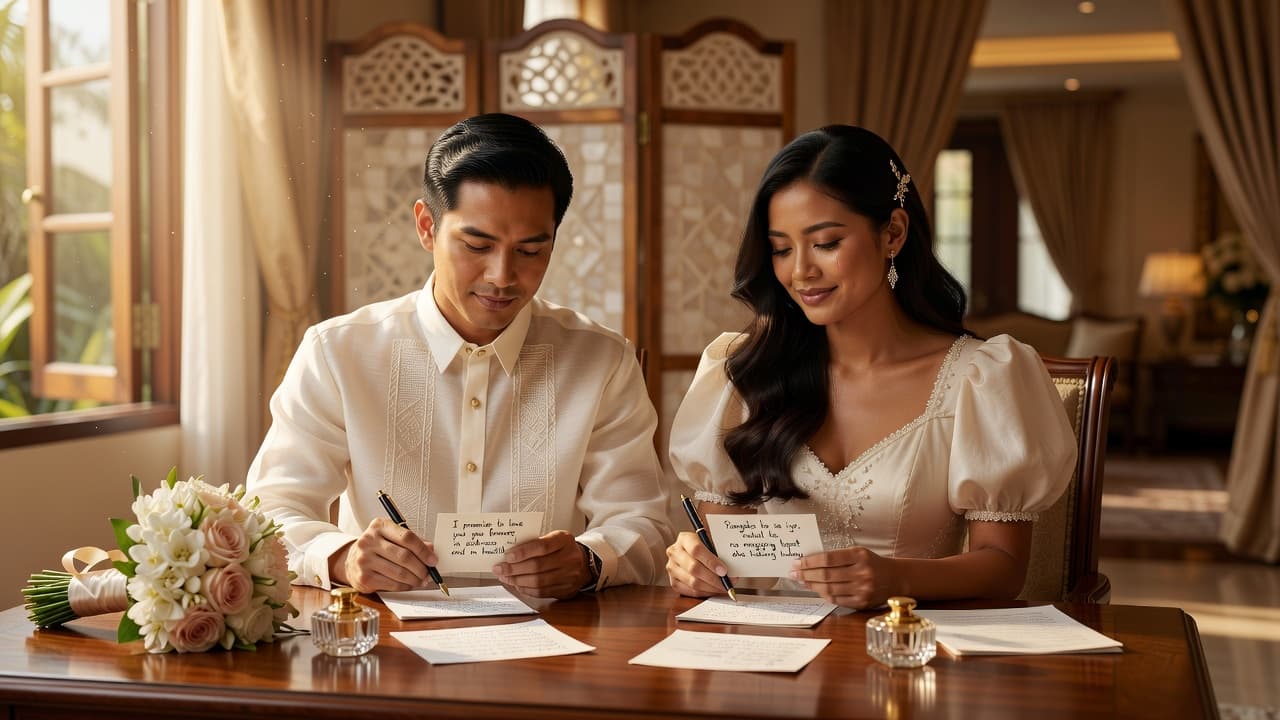
- Small cue cards: One per person, folded, with 3–5 promise headings.
- Timer rehearsal: Use your phone stopwatch so the vow fits the ceremony length.
- Partner-side check: Have your partner confirm the pacing once—no heavy critique, just timing.
- Consider support if anxiety is intense: A wedding emcee coach or public-speaking coach can help you rehearse without pressure. If the fear feels unmanageable, professional support is worth it.
[Internal link: related article on wedding ceremony timeline and rehearsal tips]
[Internal link: related article on how to choose readings, music, and program flow]
Common mistakes Filipino couples make (and how to avoid them)
- Mistake: Too long, too many ideas.
Fix: Reduce to 3–5 promises and one story sentence. If it’s over 150–180 words, cut until it feels like a conversation. - Mistake: Vague promises.
Fix: Replace “I’ll always support you” with “I’ll support you by [specific action] when [situation].” - Mistake: Forced Tagalog that feels unnatural.
Fix: Use Tagalog where your emotion is strongest; don’t translate everything if it doesn’t flow. - Mistake: Memorizing every word.
Fix: Memorize your sequence and key lines (especially your anchor line). Use cue cards for stability. - Mistake: Ignoring pacing.
Fix: Time yourself and practice with pauses. If you rush, your vow feels less heartfelt—even if the words are right. - Mistake: Forgetting the “we” tone.
Fix: Add one line that mentions teamwork—especially if you want that Filipino bayanihan vibe.
How to personalize vows for your relationship (fast brainstorming)
If you feel blank, use prompts that naturally fit Filipino wedding realities:
- What moment made you think, “I can be my real self with you”?
- When you faced stress, what did your partner do that helped?
- What do you want your home to feel like—warm, calm, joyful, disciplined, faith-centered?
- What is one “promise moment” you want to repeat through marriage?
- What values do you want your children (or future family) to learn?
Quick worksheet (fill in):
- Story sentence: “When [we met / we struggled], I realized [love insight].”
- Promise 1: “I will [action] when [situation].”
- Promise 2: “I will [action] even if [challenge].”
- Promise 3: “I will keep choosing [we/us] with [value].”
- Closing: “Today I commit to you—[signature phrase].”
Optional add-ons that make vows feel extra meaningful
These are not required, but they can elevate emotional impact when used lightly.
- A short gratitude line: “Thank you for loving me with patience.”
- A family-respect line (if appropriate): “I will welcome your family with respect and care.”
- A Filipino value word: paggalang, tapat, magkaisa, bayanihan—choose one, not all.
- A “future image” line: “When we travel, build, or grow—we do it together.”
[External link: The Knot — Wedding Vows guide (practical examples and tips)]
[External link: Brides — How to write wedding vows (checklists and style ideas)]
Key Takeaways
- Write vows in a clear structure: Story → 3–5 promises → Closing decision.
- A comfortable vow length is usually ~80–150 words (45–75 seconds) per person.
- Blend English and Tagalog naturally by using Tagalog for emotional lines and English for clarity and flow.
- Specific promises (behavior-based) sound more sincere than vague statements.
- If you’re nervous, memorize the sequence and key “anchor lines,” use cue cards, and practice timing out loud.
- When appropriate, Filipino values like paggalang and bayanihan can make vows feel culturally grounded.
Frequently Asked Questions
How long should wedding vows be for a Filipino ceremony?
Most Filipino weddings benefit from vows that are clear and audience-friendly. Aim for about 45–75 seconds per person (roughly 80–150 words). This length lets you share meaning without overwhelming guests or risking a rushed delivery during a formal schedule.
Can we write vows together, or should each person write their own?
Either approach works, but many couples prefer writing personal vows separately for authenticity. You can still collaborate on themes (respect, teamwork, faith, family) to ensure both vows match the ceremony tone. Keep each vow uniquely “yours” in voice and specific promises.
How do we blend English and Tagalog without sounding forced?
Choose a consistent pattern: use English for the setup and Tagalog for emotional lines, or start a sentence with Tagalog and finish in English for clarity. Limit Tagalog to what feels natural to say out loud, then rehearse so it flows like conversation.
What if one of us is extremely nervous about public speaking?
Reduce memorization pressure. Memorize your outline, use a folded cue card, and practice with a stopwatch. Record yourself once and adjust pacing. If anxiety feels intense, consider a short public-speaking or vow-coaching session so you feel supported on the day.
What are good promise topics for wedding vows?
Pick promises you can live out: emotional support (listening, patience), integrity (faithfulness and honesty), teamwork (bayanihan during stress), and respect (paggalang). Add one line about the future—how you want your home and marriage to grow.
Should we include family or religious language in our vows?
If your ceremony is family-centered or faith-based, a short, personalized line can be powerful. Keep it brief and specific to your beliefs and relationship. Avoid generic “wedding cliché” wording—use a sentence that sounds like something you would genuinely say to your partner.
How many promises should we include?
Most vows feel strongest with three core promises. Four or five can work if you’re concise and not repeating the same idea. A quick rule: each promise should describe a distinct action or value—otherwise, combine them.
What should we do if we blank during our vows?
Use an anchor line you’re confident saying (often your closing or a signature Tagalog phrase). Pause, breathe, look at your cue card or partner, and continue from your next promise heading. Guests usually understand—your calm recovery matters more than perfection.
Do we need to sound poetic, or should it be straightforward?
Straightforward often lands best. You can be poetic without being complicated: use vivid but simple images, short sentences, and clear promises. Poetry should serve clarity, not replace it—especially for mixed-language Filipino audiences.
Conclusion
Your wedding vows don’t have to be “perfect.” They just need to be true. When you use a clear Filipino wedding vows structure, blend English and Tagalog intentionally, and practice your pacing, you’ll create promises that feel heartfelt and easy to deliver.
Next step: If you want, draft your vows using one template above, then time-read them out loud. When you’re ready, share your draft with your partner (or a trusted friend) for pacing and clarity—small edits can turn nerves into confidence. [Internal link: related article on how to build a full wedding program and timeline]